Welcome to the Tetrahymena thermophila DNA Damage Response Database!
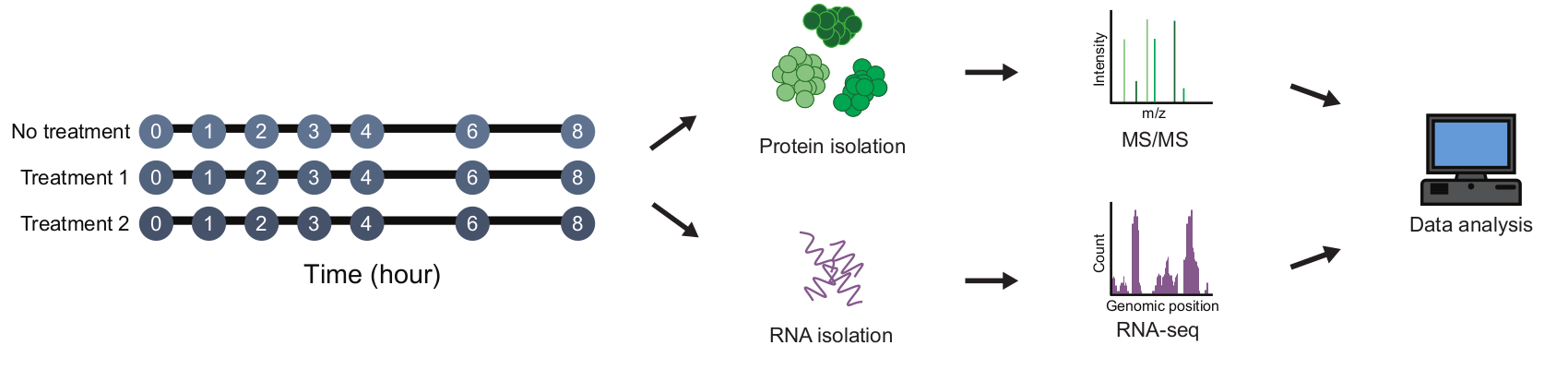
This is an interactive resource accompanying the Nischwitz and Schoonenberg et al., 2026 Genome Research publication (DOI: 10.1101/gr.281000.125). This database allows users to explore the dynamic DNA damage response in Tetrahymena across 7 time points (form 0 to 8 hours) across six treatments. You can navigate both the Proteome Data and Transcriptome Data in the tabs above.
For more information please visit our publication at Genome Research
Emily Nischwitz 1,4,* , Vivien A.C. Schoonenberg 1,5,6,* , Rachel Mullner 1,2 , Albert Fradera-Sola 1,2,7 , Susanne Zimbelmann 1 , Joshua J. Smith 3 , Falk Butter #,1
1 Institute of Molecular Biology (IMB), 55128 Mainz, Germany2 Institute of Molecular Virology and Cell Biology, Friedrich-Loeffler-Institut, 17493 Greifswald, Germany
3 Department of Biomedical Science, Missouri State University, Springfield, MO, 65897, USA
4 Current address: Diagnostic and interventional radiology, Universitaets Klinikum, 69120 Heidelberg, Germany
5 Current address: Division of Hematology/Oncology, Boston Children’s Hospital, Harvard Medical School, Boston, MA, 02115, USA
6 Current address: Molecular Pathology Unit & Center for Cancer Research, Massachusetts General Hospital and Harvard Medical School, Boston, MA, 02114, USA
7 Current address: Division Systems Biology of Signal Transduction, German Cancer Research Center (DKFZ), 69120 Heidelberg, Germany
* These authors contributed equally. Either author can be listed first.
# Correspondence: falk.butter@fli.de (FB)
Comments and bug reports to the following e-mail: albert.fraderasola@dkfz-heidelberg.de
Proteome Data
Here, you can explore the proteome data set. First (1) you can select which treatments and timepoints you would like to explore. Then (2), search for protein(s) of interest using the TTHERM ID or the standard name (as listed in the Tetrahymena Genome Database (TGD)). If no standard name is available in TGD, the corresponding S. cerevisiae homolog is listed before the TTHERM. Once you have selected your protein(s) of interest, the data table, expression line plot, and dynamicity scatter plot will automatically update to reflect your selections.
(1): Settings
(2): Select Protein(s):
Selected Protein(s):
Selected Protein(s) Expression Line Plot
Dynamicity Scatter Plot
Transcriptome Data
Here, you can explore the transcriptome data set. First (1) you can select which treatments and timepoints you would like to explore. Then (2), search for gene(s) of interest using the TTHERM ID or the standard name (as listed in the Tetrahymena Genome Database (TGD)). If no standard name is available in TGD, the corresponding S. cerevisiae homolog is listed before the TTHERM. Once you have selected your gene(s) of interest, the data table, expression line plot, and dynamicity scatter plot will automatically update to reflect your selections.